
Home · Product explainer
DJI Power 500: capacity, output and the Canadian version
What 512Wh and 1000W mean for a desk power station, and why the regional version matters before buying.
Based on WhatAFind’s Instagram posts and product information. Not a hands-on review.
A battery beside the desk
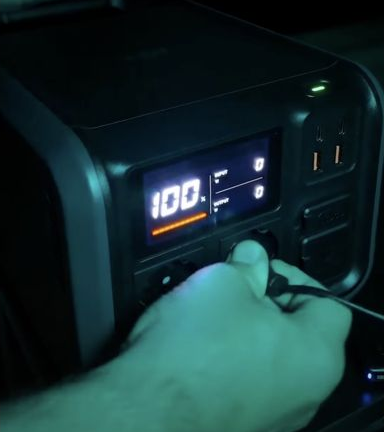
Our reel shows a compact grey power station being connected to devices at a desk. The supplied product title and the matching casing and port layout identify it as the DJI Power 500. The appeal is straightforward: several power connections in one portable box. This guide uses DJI’s published specifications and the visible reel; it is not a hands-on runtime, charging-speed or outage-transfer test.
512Wh and 1000W answer different questions
DJI lists a 512Wh battery capacity and up to 1000W continuous AC output, with that maximum available above 20% battery charge. Watt-hours describe stored energy; watts describe the rate at which power is delivered. The 1000W figure does not turn this into the Power 1000 model, and it does not mean every connected load will run for an hour. For planning, compare both the combined running demand of your devices and any startup demand with the manufacturer’s limits. Actual runtime also depends on conversion losses and operating conditions; the reel does not establish it.
Choose the connections your devices need
DJI specifies two AC outputs, two USB-C ports, two USB-A ports and one SDC Lite port. Each USB-C port supports up to 100W output with a compatible PD 3.0 device. Check the charging requirements of your laptop or other device rather than assuming every USB-C connection delivers its maximum. Port count alone does not establish that all connected devices can draw their individual maximum power simultaneously.
Portable still needs a place to sit
DJI gives the Power 500 a weight of approximately 7.3kg and dimensions of 305 × 207 × 177mm. Think about where you would carry it, where the cables would run and whether its controls remain accessible. Follow the model’s manual for placement and ventilation. The video shows a desk arrangement, but it does not verify safe operation in an enclosed cabinet or uninterrupted operation of a particular computer during a power cut.
The Canadian version is the unresolved detail
DJI distinguishes DYM500L, with 100–120V AC output, from DYM500H, with 220–240V AC output. The unit in our reel has European-style sockets, so the footage should not be treated as a photograph of a confirmed Canadian configuration. Before buying for Canada, confirm the actual model label, rated input and output, socket type and included power cord for the unit being shipped. We are leaving out the Amazon shopping link until a matching Canadian version is confirmed.
What this find is useful for
The Power 500 is worth considering when you want a portable battery with a mix of AC and USB connections and your devices fit its documented limits. Start with a list of the equipment you want to power and the duration you need, then compare it with manufacturer guidance for the exact regional unit. Our reel demonstrates the product’s form and connections; it does not substantiate broad claims about powering every device, handling multiple heavy loads or protecting a workflow without interruption.
Shopping link pending
DJI Power 500
Sources
DJI Power 500 — official specifications
DJI Power 500 — official support and manuals
Catalogue details and retailer destination
Sources checked October 22, 2026. Product claims are attributed to the linked sources; unverified performance claims are not presented as test results.